

The reading, already done.
Your executed agreements hold every rate you collect on and every term that governs them. Basalt reads all of it, puts each figure on one grid beside the page it came from, and computes percent of Medicare per facility per payer from real CMS files. Which means the number you take to the table is one you can source on the spot.
If a major payer agreement reopens in the next twelve months, someone has to read it before you sit down. That work is happening either way.
The spreadsheet is the symptom.
Someone abstracted every rate by hand to build it. Next cycle, someone does it again, because nothing was retained in a form anyone else can use. It goes stale the day an amendment lands, and no cell traces to a page. When the payer disputes a number, a person's memory is what you have.
Counted from a live reference deployment at a 60+ hospital multi-state system, proven at four facilities on a repeatable pipeline.
Four steps, one pass.
Basalt does the reading and the citing. Your analyst confirms the flags, with the page on screen beside the figure.
Agreement handed over
Executed contracts, amendments and appendices, in whatever form they were signed and filed.
Read and extracted
Basalt reads every page and pulls each rate and provision with the document and page it came from.
Computed and flagged
Percent of Medicare is computed per facility per payer from real CMS files, and anything the documents disagree about is surfaced.
Confirmed and ready
Your analyst clears the flags with the source line in view. Basalt assembles the evidence; the person who signs the deal decides what to do with it.
Three things have to be true for any of this to hold.
It has to read the documents as they were filed, check them against your own executed language, and show its work on every figure.
Built for the filing cabinet it came out of.
Executed agreements arrive as scans, faxes and photocopies of photocopies, with the appendix that matters somewhere in the back. Basalt reads them as they are, with no clean data feed required.
- Scanned multi-document agreements
- Amendments that supersede the rates they replace
- Fee schedules, appendices, letters of agreement, side letters
Checks against your own executed language.
Every agreement is written differently. Basalt reads yours against a 62-slot provision standard you can edit in the product, so a term that is missing is recorded as missing after a full read.
- Per-facility, per-payer rates on one grid
- Escalators, notice periods, termination grounds
- Risk, review or cited, each with a plain-English reason
Every figure traces back to the page.
Any vendor can extract a rate. The question is whether you will put that rate in front of a payer under your own name. Each figure links to the line it was read from, so you can verify in one click and answer the question the moment it is asked.
- One-click source citations on 10,496 of 10,497 fields
- The verbatim source quote on 9,462 of them
- Roughly 35 independent checks gate every deploy
Four questions you should be able to answer cold.
These are the ones your team gets asked in the room, with the payer's analyst sitting on the other side. If you already run a contract lifecycle system, it stays the system of record for the paper. Basalt is the system of record for what the paper says, which is what these four turn on. Most systems run both.
Where is my worst deal?
Every payer set against every other and against Medicare, facility by facility, on one grid. Percent of Medicare is computed from the CMS FY2026 IPPS files, with the FY2027 proposed rates available alongside.
What changes what I actually collect?
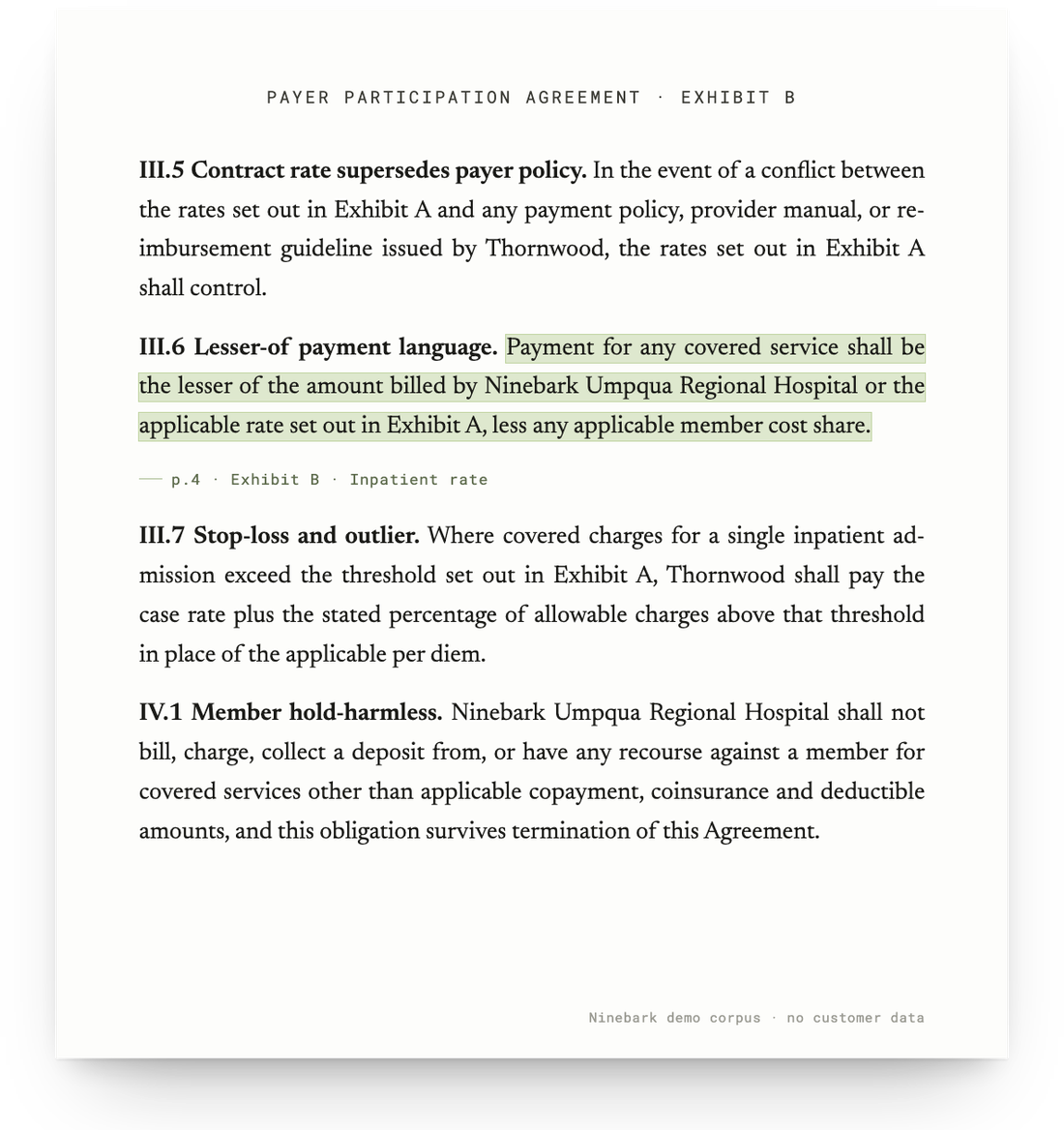
The rate is one line. Timely filing, lesser-of language, carve-outs and the escalator decide what lands in the bank. Basalt reads all of them and shows which clause is doing the work.
Who can change my rates without asking?
In the reference book, 3 of 45 contracts are payer-controlled, 22 agreement-controlled, and 10 are shown as unresolved with the reason. A term nobody has read is one you find out about after it moves.
What did I actually win last cycle?
Compare the current agreement against the version it replaced, term by term, with both pages on screen. What moved, what held, and what quietly changed while nobody was reading the appendix.
There are twenty-four of these questions. The full negotiation prep checklist is here.
See it on the contract you argue with most.
Twenty minutes, your own agreement, and the page beside every figure Basalt reads out of it. Most systems start with one payer and one negotiation cycle.